

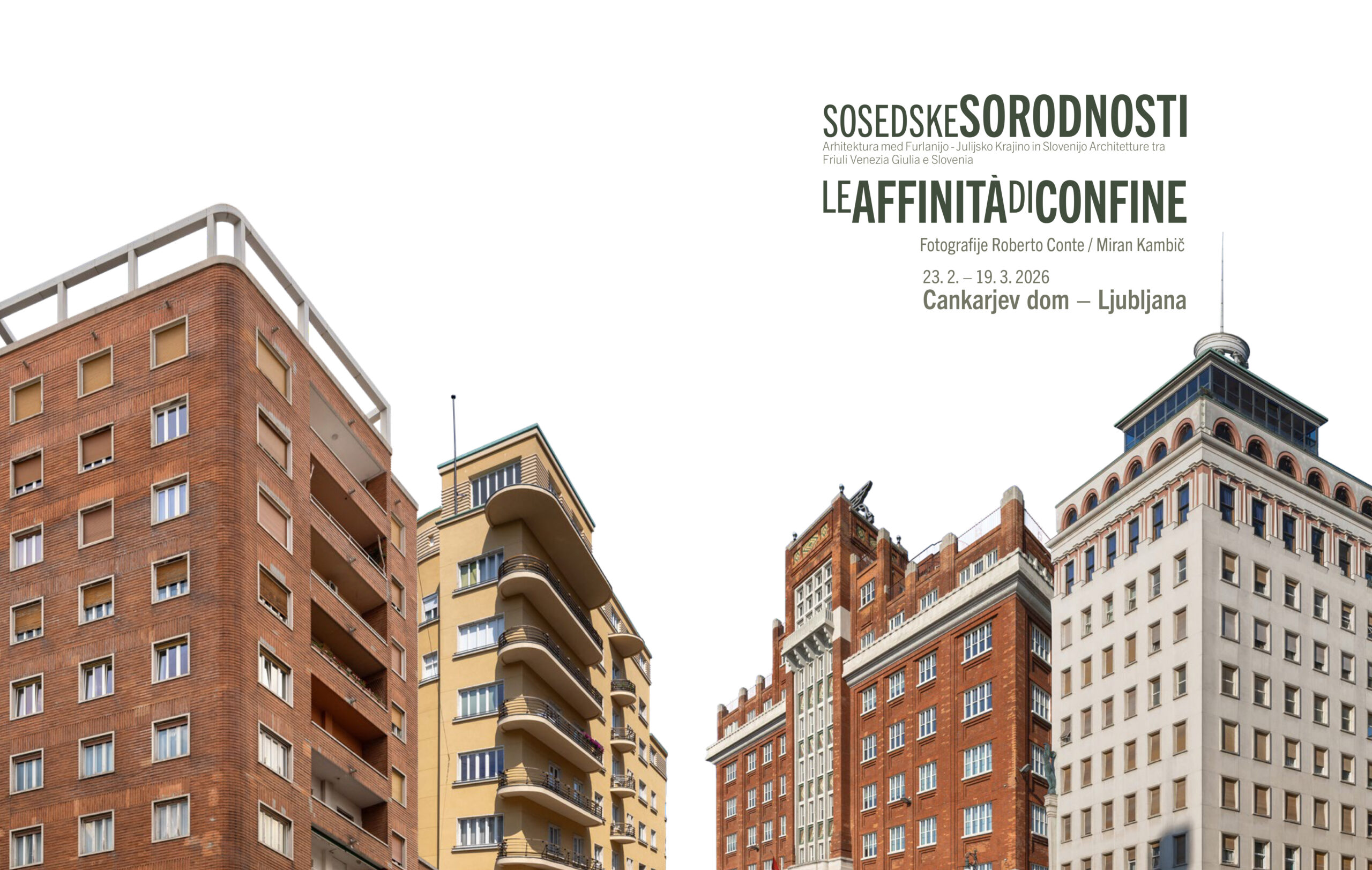
The exhibition Border Affinities. Architecture between Friuli Venezia Giulia and Slovenia / Le affinità di confine. Architetture tra Friuli Venezia Giulia e Slovenia brings together two countries (Slovenia and Italy), two photographers (Miran Kambič and Roberto Conte) and two curators (Luka Skansi and Paolo Nicoloso).
The opening of the exhibition will take place on Monday, 23 February at 7 p.m. in the Grand Reception Hall of Cankarjev dom, and it will be on view until 19 March.
The exhibition in Ljubljana is organised in collaboration between Open House Slovenia (OHS), Cankarjev dom, the Embassy of the Republic of Italy in Ljubljana, the Italian Cultural Institute in Ljubljana, ERPAC, and the Ministry of Culture of the Republic of Slovenia.
Border Affinities. Architecture between Friuli Venezia Giulia and Slovenia
/ Le affinità di confine. Architetture tra Friuli Venezia Giulia e Slovenia reveals the century-long architectural dialogue between Slovenia and Italy in an as yet unseen way. With carefully paired diptychs, it uncovers surprising parallels between cities, cultures, and nations whose ties have always been closer than meets the eye, and raises questions about the boundaries in human memory, perception, and shared cultural space. The exhibition features eighty large-format photographs taken especially for the project, investing it with a rare visual, research, and documentary value. Exploring the parallels, similarities, and differences between architecture in Slovenia and Friuli-Venezia Giulia in the last 150 years, the project perceives space as a historical document, a cultural bond, and a live medium of human identity.
The chosen reference point for this exploration is the diptych, i.e. the side-by-side juxtaposition of images of buildings constructed in the two countries.
The Slovenian part of the presentation features prominent architectural landmarks, including works by Jože Plečnik, Edvard Ravnikar, Oton Jugovec, and Boris Podrecca, as well as projects by younger architects, including the architectural firms Arrea, Bevk Perović arhitekti, Dekleva Gregorič arhitekti, Ofis arhitekti, and others. The exhibition raises fundamental questions about how buildings separated by a distance of a few tens or hundreds of kilometres tend to show surprisingly similar cultural ambitions, and how architectural form displays the political and social ideologies of various historical periods.
The exhibition explores how history has the power to imprint itself on both urban and architectural fabric and how these layers of time continue to shape our perception of the region today. Organized into chronological chapters, from the Austro-Hungarian era, the interwar years, the socialist Yugoslavia, and the post-war modernization and transformation of the region, Border Affinities reflects the depth of architectural dialogue between two geographically close yet historically divided realities over the last century and a half.
The exhibition Border Affinities. Architecture between Friuli Venezia Giulia and Slovenia / Le affinità di confine. Architetture tra Friuli Venezia Giulia e Slovenia was on view in Trieste, at the Magazzino delle Idee (Warehouse of Ideas), between 3 July and 30 November 2025, and formed part of the accompanying programme for GO! 2025 – European Capital of Culture Nova Gorica/Gorizia. The newly staged exhibition in Ljubljana’s Cankarjev dom presents the Slovenian public with an engaging visual narrative, a multifaceted portrait of the shared architectural and cultural history of two regions, two nations, and two neighbouring cultural spaces.
Patrons of the exhibition in Ljubljana:
TOSIDOS, Construction Engineering and Execution, Ltd.; Protim Ržišnik Perc, GDH Ltd.; Association of Architects of Ljubljana; Illy Slovenia – Espresso Ltd.
Leave A Comment
You must be logged in to post a comment.